


Speech – Rotary Club – Economic Development
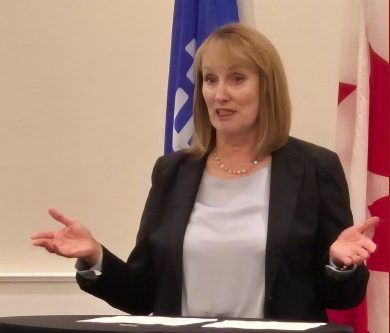
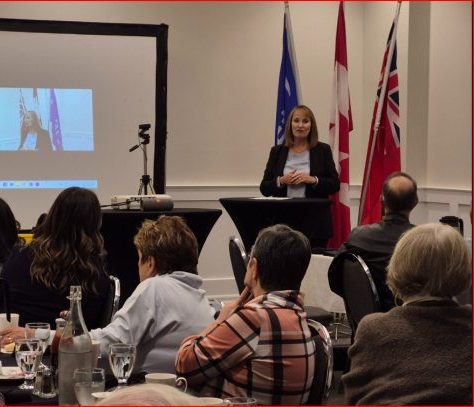
Hello to all members of the Rotary Club of North Bay,
Early in my career at the Business Development Bank of Canada, I spent a lot of time working with the Canadian Chamber of Commerce to make October Small Business Month in our country. That’s why I’m particularly pleased to be here in October as part of your club’s Economic and Community Development Month.
Over the years, I have followed your club’s role in promoting economic growth and social well-being in North Bay. Congratulations to all of you for your leadership in making a tangible difference in North Bay.
As we gather after Thanksgiving, I hope you had a wonderful time with your family and friends over a delicious meal… perhaps even one that included turkey.
While enjoying my turkey, I wondered whether its price had increased or decreased compared to last year. So, I did a Google search.
Can you guess what I found?
It decreased. According to Dalhousie University, the overall price of our Thanksgiving dinner, including turkey, stuffing, carrots, cranberry sauce, mashed potatoes, and gravy, has increased slightly by a few cents compared to last year… and potatoes are the reason.
Over the years, the price of turkey in Canada has fluctuated, shifting from a seasonal food, eaten mainly at Thanksgiving and Christmas, to a meal enjoyed year-round, due to changing consumer preferences and food trends. The price of turkey has been influenced by many factors:
- including the price of feed, which has been affected by weather events and geopolitical tensions;
- labour shortages in agriculture and new animal welfare regulations have also played a role;
- then there was the avian flu outbreak and;
- we have the impact of the Canadian food market dominated by a few large chains.
This brief discussion helps us understand how even the price of a Christmas turkey can tell us a lot about our country’s economic journey.
So today, I’d like to talk about two things:
1) Canada’s economic journey and why the world needs Canada more today;
2) North Bay’s economy and why the world needs North Bay more.
Over the past five years, our country has been affected by many factors… and I would like to present the following list as we prepare to present a budget on November 4 and emphasize that what we are currently experiencing from an economic standpoint is not so different from what other countries are facing.
- The COVID-19 pandemic, which began in late 2019, has had a significant impact on economies around the world. Since then, nations have faced a series of interrelated economic challenges.
- One of these challenges concerns global supply chains. During the pandemic, they have experienced significant disruptions, including lockdowns, border closures, and labour shortages. These disruptions led to delays in manufacturing and shipping, increased costs, and shortages of essential products. While some supply chains have stabilized, vulnerabilities remain, particularly in critical sectors such as food and energy.
- Supply chain disruptions have led many countries to face surging inflation rates at levels not seen in decades… You may recall that in June 2022, they reached 8.1%, compared to 1.9% today.
- This situation has been exacerbated by the war in Ukraine, which continues to impact energy and food costs.
- The pandemic has resulted in millions of workers losing their jobs, prompting governments to implement stimulus and support programs. The rise of remote working and changes in the skills sought have altered the employment landscape. Some sectors, such as hospitality and tourism, have struggled to recover.
- Governments around the world have responded to the pandemic with unprecedented fiscal stimulus measures: direct payments, business support, and health spending. As a result, global public debt has reached record levels, raising concerns about long-term fiscal sustainability, future tax burdens, and the ability to respond to new crises.
- In response to lockdowns and social distancing, businesses and governments have rapidly adopted digital technologies… starting with Zoom! While this has fostered innovation and created new opportunities, it has also brought to light new issues related to cybersecurity and the need for robust data governance.
- While global supply chains and technology have lifted millions out of poverty, many communities in advanced economies have felt left behind, fueling populist movements and political polarization.
- Then came Trump, who intensified existing geopolitical rivalries, particularly between the United States, China, Russia, and India.
- And finally, we have tariffs that were imposed, and since then, competition for critical resources has complicated international cooperation and economic recovery efforts.
Our Prime Minister accurately describes the situation when he says that the world order is in flux.
Fortunately, as we navigate this increasingly difficult period that has impacted our auto, steel, aluminum, and lumber industries, Canada continues to benefit from strong economic fundamentals.
- I already mentioned our inflation rate, but there is also our labour force participation rate, which stands at 65%, well above the U.S. rate of 62%, and then, in September, our economy created 60,000 jobs.
- Our country’s interest rates are among the lowest in the G7.
- Our net debt-to-GDP ratio and deficit are the lowest in the G7.
- And our credit rating is the highest in the world, at triple AAAs.
- What’s more, the International Monetary Fund and the OECD predict that Canada will have the strongest economic growth in the G7 this year!
But we all know we must do better. Our country does have a deficit, and we, as responsible Canadians, want to see it reduced. At the same time, we Canadians do not want to pay more taxes or see our social benefits reduced. These are sacred.
That is why Canadians elected a Prime Minister, and a government committed to building the strongest economy in the G7 here in Canada. Here are some of the key measures being implemented to achieve this.
- As you know Canada is accelerating the development of major projects that further exploit Canada’s natural resources and essential minerals, while encouraging interprovincial trade through a “Buy Canadian” program that will be launched soon.
- At the same time, Canada is investing in housing and defense plans that will not only create jobs, but also include the use of Canadian-made steel, cement, and wood products.
- To fund these projects, we are advancing tax credits for significant economic investments and unlocking pension investments.
- We will propel investments in Canadian companies that want to go global, enter new markets, establish new partnerships, and compete beyond North America. We need bigger Canadian companies that will help increase our influence in the world.
- Finally, we will consolidate Canada’s advantage in artificial intelligence to strengthen its position as a global leader. I would add that the government will soon unveil a new strategy to attract talent focused on AI and other emerging technologies, while promoting Canada as an open and ambitious society. We are determined to win the global talent race by committing to attracting the best talent in the world and making Canada the destination of choice for the brightest minds, thanks to our support for science and research in universities.
Our Prime Minister recently addressed the United Nations in New York. At that event, he was in high demand, receiving a record 700 requests for meetings from world leaders, CEOs, and business leaders. To me, this is a clear testament to Canada’s vision. It is a testament to confidence. As we strive to build the strongest economy in the G7 and attract substantial investment to achieve this, one of the most important leading indicators is confidence, because changes in sentiment often precede actual changes in economic activity. Increased business and investor confidence can lead to more hiring and capital investment.
Mark Carney explains it this way: « Canada has what the world wants, and the world is taking notice.
Canada has the resources, expertise, and values that are in high demand around the world. By leveraging its strengths in natural resources, climate leadership, agriculture, strong institutions, and diversity, Canada is well positioned to help solve global challenges and stimulate growth in its economy.
And as previously noted, Canada has the right values. We will protect sectors threatened by tariffs with targeted financial assistance, while helping them adapt and shift to new products and markets. One example is the $400 million loan to Algoma Steel to help the Canadian steel maker shift to a growing domestic market through major projects, defense, and housing.
In the coming weeks, Canada will release its fall budget to address the challenges and opportunities described above. As a member of the Standing Committee on Government Operations and Estimates, I look forward to being at the forefront of many of the discussions surrounding this process. I know there will be a lot of discussion about the new calendar, about the fact that budgets will now always be released in the fall to coincide with the construction season in Canada. There will also be a lot of discussion about what constitutes capital spending, as Canada reorganizes its spending into operating or capital expenditures. There will be half-truths.
One thing is certain. Our government’s prudent fiscal management is one of the pillars of Canada’s economic strength. By maintaining sustainable debt levels and implementing responsible fiscal policies, we will ensure that Canada is well positioned to meet challenges, invest in our future, and provide essential services to all Canadians, today and tomorrow. Our stable credit rating and low risk profile are a testament to this ongoing commitment.
Which brings us to North Bay.
In 2025, North Bay’s economy also reflects both resilience and adaptation, as it remains stable. The city’s finances are healthy, and unemployment rates have remained relatively stable, fluctuating close to the provincial average.
But like Canada, North Bay faces challenges. We face issues of affordability, affordable housing, social issues, access to healthcare, youth exodus, limited employment opportunities, and a shortage of skilled labor. There are also challenges that arise suddenly, such as the cancellation of Air Canada services, and here, stakeholders are quickly mobilizing to find solutions.
Like Canada, North Bay has unique assets. Our location as a gateway to northern Ontario and northern Canada, our proximity to major transportation routes, and our access to beautiful lakes and forests, to name a few, offer us opportunities in sectors such as tourism, transportation, education, health, mining, and defense. The region is well positioned to remain a leader in the Canadian mining industry as it continues to invest in workforce development, sustainable practices, and engagement in the global marketplace. On the defense side, there are efforts to expand the influence of our air base and NORAD to contribute more to Canada’s national defense infrastructure.
That said, given the economic trajectory Canada is on, I find myself thinking about what North Bay has that the world and Canada might need more of.
I think this way because of the environment I am currently in.
Since the government passed the One Canada Economy Act, which aims to build a single Canadian economy and deliver on major projects, I have seen Canadian regions, industries, and businesses competing for projects. They travel to Ottawa or organize online conference calls to present their ideas, their projects, their region… their offer. There is an ongoing dialogue in Canada about what is needed to build an economy that is adapted to this rapidly changing world. From my perspective, this ambition expressed by Canadians is also a strong leading indicator that reflects our confidence in our country.
Here in Ontario, we heard Premier Ford present our province’s list of national projects, which includes the Darlington small nuclear reactor project, the development of a port on James Bay that will enable the ONR rail connection between southern Ontario and Moosonee (North Bay Gateway to the Word) the development of the Ring of Fire and ongoing work on the construction of the highway, the Highway 401 road tunnel, and the development of the St. Lawrence East Port. Our provincial representative is traveling the world to realize Ontario’s ambitions.
From North Bay, the city has supported, through FONOM and the Association of Mayors of Large Cities, the call for the expansion of Trans-Canada Highways 11 and 17, which cross northern Ontario.
With a comprehensive approach that includes twinning, 2+1 projects, and lane widening, this could be feasible. We are trying to position this project as a nation building project. As we strive to develop a single Canadian economy, it is unacceptable that the only section of the Trans-Canada Highway that is not widened is the one that runs through northern Ontario. With the Ontario Ministry of Transportation predicting a doubling of traffic on our roads over the next decade, the efficient and safe use of roads is a priority. It is encouraging to see all communities in northern Ontario coming together to express the need for this project.
All these national construction projects require proponents, investments, and obligations on the part of the Major Projects Office, which must consult with the First Nations involved and ensure that our country’s environmental commitments are met.
These remarks bring me full circle and back to the Rotary Club.
As you well know, North Bay is an exceptional community, and the world needs more communities like North Bay.
And that’s where the Rotary Club can play a role, if you choose. With more than 100 years of experience and as a member of Rotary International, your influence extends far beyond the borders of our city. Your club’s vast network allows you to participate in global initiatives with a reach and effectiveness that few organizations can match. You have been at the forefront of addressing global challenges, including maternal and child health, education, and peacebuilding. So, could the club play a role in examining global needs that North Bay could address?
Regardless of whether you choose or not to pursue this question, simply by promoting dialogue, as you have always done, you will continue to support North Bay as it remains a resilient community in this dynamic world we live in. Thank you for your dedication, service, and belief in an always better world.
______________________________________________________________________
| Pauline Rochefort, MP Nipissing – Timiskaming paulinerochefort.libparl.ca [email protected] |
North Bay Constituency Office 375 Main St. W. North Bay, ON P1B 2T9 705-474-6155 |
Temiskaming Shores Constituency Office 65 Whitewood Ave. W. New Liskeard, ON P0J 1P0 705-647-6262 |
| /MPPaulineRochefort | mppaulinerochefort | /Pauline-Rochefort |
 X
X